Guide
Generative engine optimization: a contractor's guide
Generative engine optimization (GEO) is the work of getting AI assistants like ChatGPT, Google AI Overviews, Gemini and Perplexity to mention, describe correctly and recommend your business when people ask them questions. It builds on SEO basics, then adds tracking of what AI tools say about you, fixing the gaps, and publishing content that answers the exact questions buyers ask. For a contractor, the goal is simple: be the company AI names when a homeowner asks who to hire.
What is generative engine optimization?
Generative engine optimization, or GEO, is the practice of making your business easy for AI tools to find, understand, trust and recommend. When a homeowner types 'who is the best roofer near me' into ChatGPT, the answer is a short list of names. GEO is how you get on that list, and how you make sure what the AI says about you is accurate.
Own Your GEO sells done-for-you GEO (generative engine optimization, also called AEO or answer engine optimization) products and AI consulting to contractors and construction trades. We work with roofers, HVAC companies, plumbers, remodelers, fence companies, landscapers and other home service and construction businesses across the United States.
Here is the short version of how GEO works:
- Ask the AI tools what buyers ask. Run real customer questions through each engine every week (Meta AI monthly, to keep costs down).
- Record who gets named and who gets cited. Note which businesses show up and which websites the AI pulls its facts from.
- Fix what is missing. Add clear answers, consistent business facts and pages that cover the questions you are losing.
- Measure again. Track whether your share of answers goes up, and which leads came from AI.
That loop never stops, because AI answers change from week to week.
If you want the trade-by-trade version, read our GEO guide for contractors.
What is GEO instead of SEO?
SEO (search engine optimization) is about ranking in the list of blue links on Google. GEO is about being included in the written answer an AI gives. The two overlap a lot, but they are not the same job.
| SEO | GEO | |
|---|---|---|
| Where you show up | Google's list of links | Inside AI answers (ChatGPT, AI Overviews, Perplexity and others) |
| What 'winning' looks like | A high ranking position | Being named, described correctly and cited |
| How many winners | 10 links on page one | Often 3 to 5 names in one answer |
| What you measure | Rankings, clicks | AI visibility, share of voice, cited websites, AI leads |
| How the buyer acts | Clicks and compares sites | Often takes the AI's short list and calls |
The big difference for a contractor is the size of the list. On Google, a homeowner might scroll past ten companies. In an AI answer, they may see only a handful. If you are not one of them, you are not in the running.
Google itself says that pages appearing in AI Overviews and AI Mode must be indexed and eligible to show a snippet, and that there are no special extra technical requirements (source: Google Search Central, AI features and your website). So a healthy website still matters. GEO is what you do on top of that.
What is AI engine optimisation?
AI engine optimization is another name for the same idea. You will also hear AEO (answer engine optimization), 'AI SEO' and LLM optimization. The labels change depending on who is talking. The work is the same: get AI tools to give accurate, favorable answers about your business.
If a vendor tells you AEO and GEO are totally different services you need to buy separately, ask them to show you what changes in the actual work. In our experience, it is one job with several names.
Is SEO dead now with AI?
No. AI tools still lean on websites to build their answers. Many of them search the web in real time and then summarize what they find. If your site is slow, hard to crawl or thin on real answers, the AI has less to work with.
What has changed is where buyers look. Some homeowners still Google and click. Others ask ChatGPT or read the AI Overview at the top of Google and never scroll. A contractor needs to show up in both places.
Think of it this way:
- SEO keeps you eligible. Your pages get indexed and can be found.
- GEO gets you chosen. Your business gets named in the answer.
Dropping SEO would be a mistake. Ignoring GEO is also a mistake, because you cannot see AI answers in a normal rank tracker. You have to ask the engines directly and record the results.
Which AI engines does generative engine optimization cover?
There is no single 'AI search.' Each engine pulls from different sources and gives different answers to the same question. A business can be the top pick in one and missing in another.
The Custom GEO Package tracks these engines, every week except Meta AI, which is checked monthly:
- ChatGPT
- Google AI Overviews and AI Mode
- Gemini
- Perplexity
- Claude
- Meta AI
- Grok
Tracking all of them matters because your customers do not all use the same tool. A younger homeowner might ask ChatGPT on their phone. Another might just read the AI Overview on Google. A property manager might use Perplexity at work.
What does 'search engine optimization' mean, and where does GEO fit?
Search engine optimization means improving your website and online presence so search engines show you to more of the right people. It covers technical health (your site loads and can be crawled), content (pages that answer real questions) and trust (reviews, links and consistent business details).
GEO uses all three of those, then shifts the focus:
- From keywords to questions. AI users type full questions, like 'what does a new HVAC system cost and who installs them well.' Your content needs to answer those directly.
- From rankings to mentions. The question is not 'what position am I in' but 'am I named, and what does the AI say about me.'
- From your site to the whole web. AI tools cite directories, review sites, forums and news. GEO looks at which websites the AI is citing in your trade and makes sure your business is represented there.
- From one-time to weekly. AI answers shift often. You need a steady rhythm of checking and fixing.
How does generative engine optimization work for a contractor?

Here is what a working GEO system looks like in practice, using the Custom GEO Package as the example. Everything below is included.
A GEO dashboard. You see your AI visibility, how you stack up against competitors, and which websites the AI engines are citing when they answer questions about your trade.
500 AI searches a week. The system runs real buyer questions through the engines every week. You can scale that up to as many searches as you want to pay for.
A live activity board. Instead of a vague report, you get a running list of what to fix next, in order.
A built-in content agent. Each week, it takes that week's search findings and writes new content aimed at the questions where you are losing.
AI lead tracking. You can see which leads came from AI tools, so you know whether the work is paying off.
30 days of hands-on fixes and training. We make the fixes with you and train your team, then hand the system off.
Bonuses. Three custom GEO pages for your website, closest-competitor tracking, and a custom ideal-customer persona so the content speaks to the jobs you actually want.
The key word is own. The system runs on your accounts. There is no retainer and no annual contract, just a simple sales agreement at purchase. Running costs are about $150 a month, paid directly to the AI providers, not to us. We explain why this matters in why rent your GEO when you can own it.
What results can GEO produce?
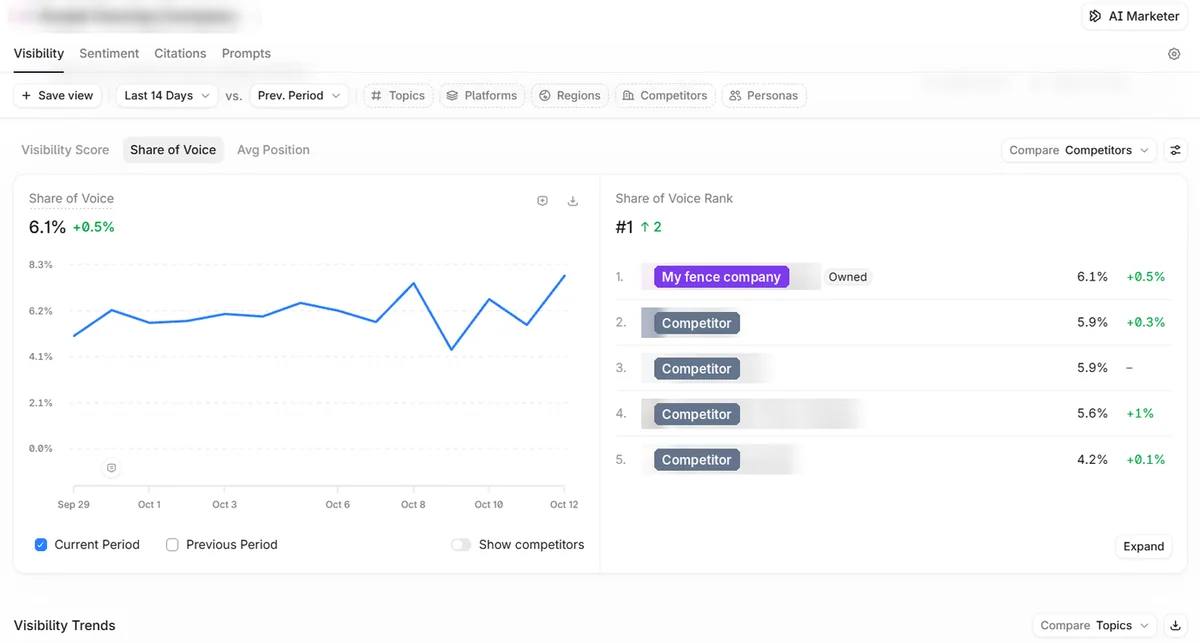
Joseph, founder of Own Your GEO, built this system for the fence company he founded. Here are that company's results as of October 2026:
- #1 in AI visibility, measured by Promptwatch.
- #1 in AI share of voice, measured by Profound.
- #2 most-cited website in AI answers about fencing in its city, behind only Google.
- #1 on 'who should I hire' questions in the owner's own GEO system.
Two things to notice. First, the results come from outside tools (Promptwatch and Profound), not only our own dashboard. Second, the 'who should I hire' result is the one that turns into phone calls. Being cited is nice. Being recommended is what pays.
We keep our numbers honest and like-for-like. We compare the same questions, on the same engines, over time.
How can I start GEO as a beginner?
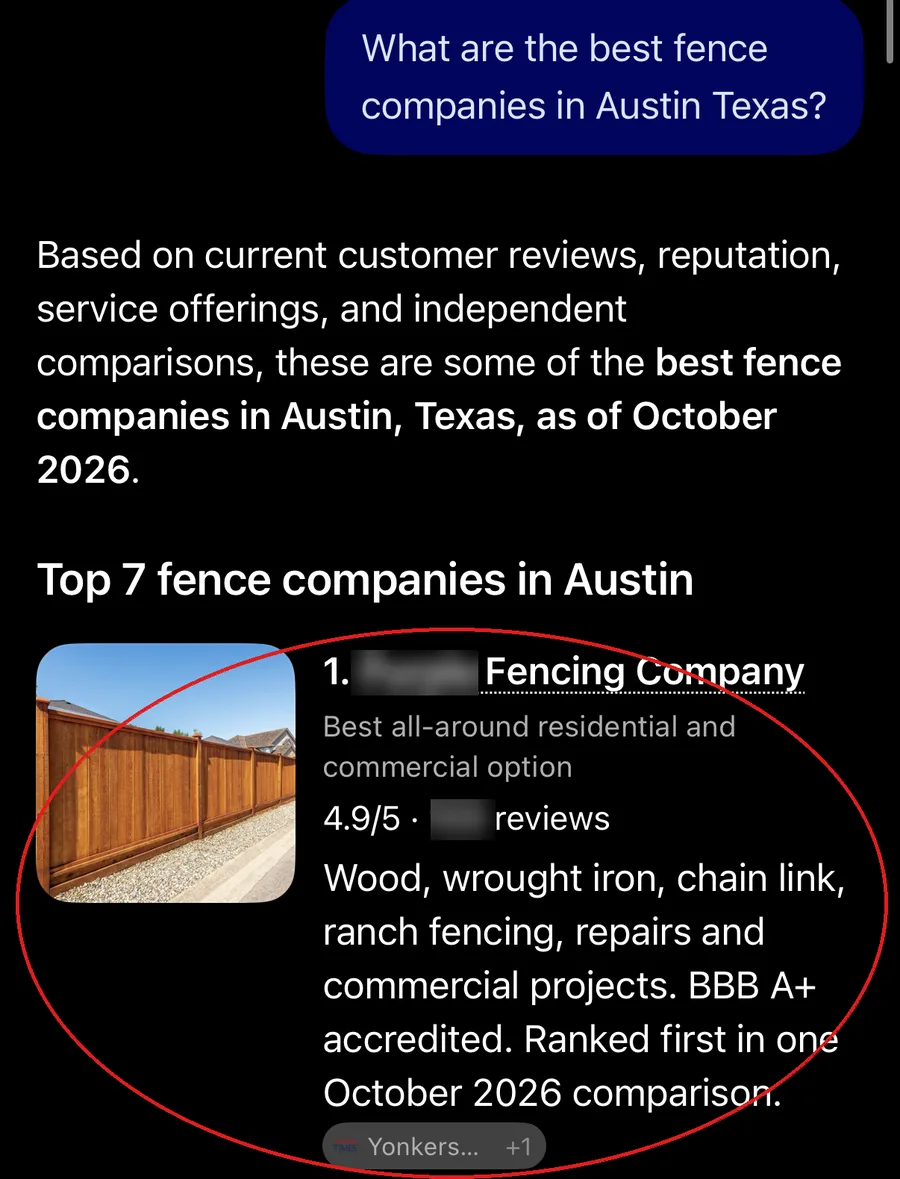
You can take the first steps yourself this week. None of these need special tools.
- Ask the AI tools about yourself. Open ChatGPT, Gemini, Perplexity and Google. Ask 'who is the best [your trade] in [your city]?' and 'what do people say about [your business name]?' Write down who gets named.
- Check your facts. Is the AI getting your services, service area and contact info right? Wrong facts usually come from old or mismatched listings.
- Make your business details match everywhere. Use the same business name, phone, address, services and description on your website, Google Business Profile and directories.
- Answer real questions on your site. Write pages that answer what homeowners ask on the phone: cost ranges, timelines, materials, what happens on install day. Put the answer in the first two sentences.
- Look at who gets cited. In Perplexity and Google AI Overviews, check the sources. If the same directory or review site keeps showing up, make sure your profile there is complete.
- Repeat monthly. Track whether you appear more often.
The hard part is doing this across eight engines and hundreds of questions every week. That is where a system helps. Trade-specific examples are in our guides for roofers and other trades.
Where can I get certified in SEO or GEO?
There are many online SEO courses and certificates, and they can teach you the basics. But for a contractor, a certificate is not the goal. AI tools do not check whether you or your marketer holds a certificate. They look at what is published about your business and how clearly it answers buyer questions.
If you want to learn, a better path is to practice: run the beginner steps above, track the results and adjust. If you would rather have someone build the plan with you, the AI Game Plan is built for that.
Should you hire a GEO agency or own your GEO system?
Most agencies sell GEO as a monthly service. You pay every month, and the tools and data usually stay with them. That can work. But when you stop paying, you often lose the system.
Our approach is different. You own it. We work only with construction businesses. We are hands-on for 30 days, then hand it off. To compare options, see our roundup of GEO agencies for contractors.
What does generative engine optimization cost?
Here are our two paid options.
| AI Game Plan | Custom GEO Package | |
|---|---|---|
| Price | $1,500 one time (regular $4,000) | $5,000 one time founding client price for the first 5 clients, then the regular $10,000 |
| What it is | One-time AI consulting | Done-for-you GEO system you own |
| Includes | 90-minute session on leads, follow-up, estimates, scheduling, reviews and admin; written action plan; AI visibility snapshot; at least 3 custom GEO content pages; 14 days of email support | Dashboard, activity board, 500 AI searches a week, content agent, AI lead tracking, 30 days of hands-on fixes and training, plus 3 GEO pages, competitor tracking and an ideal-customer persona |
| Ongoing costs | — | About $150 a month, paid directly to the AI providers |
| Contract | One time | No annual contract, simple sales agreement |
| Guarantee | No results guarantee (it's consulting advice) | 90-day money-back guarantee for clients who follow the system's recommendations |
A $500 deposit holds a Custom GEO Package spot and counts toward the total. If you start with the AI Game Plan, the full $1,500 counts toward the Custom GEO Package if you upgrade within 60 days. Learn more about AI consulting for contractors.
Not sure where you stand yet? Start with the Free AI Visibility Snapshot. It shows how AI tools see your business today.
Get your Free AI Visibility Snapshot: email [email protected] or book a free call.
Questions
What is generative engine optimization in simple terms?
It is the work of getting AI tools like ChatGPT, Google AI Overviews and Perplexity to name and recommend your business when people ask them questions. It also makes sure what they say about you is accurate.
Is GEO the same as AEO?
Yes, for practical purposes. GEO (generative engine optimization) and AEO (answer engine optimization) describe the same goal: showing up accurately in AI-generated answers.
Do I still need SEO if I do GEO?
Yes. AI tools rely on websites to build answers, so your site still needs to be indexed and easy to crawl. GEO builds on top of that foundation.
How much does the Custom GEO Package cost?
It is $5,000 one time at the founding client price for the first 5 clients, then the regular $10,000. Running costs are about $150 a month, paid directly to the AI providers.
Is there a contract or retainer?
No retainer and no annual contract, just a simple sales agreement at purchase. The system runs on your accounts, so you own it.
Which AI engines do you track?
ChatGPT, Google AI Overviews and AI Mode, Gemini, Perplexity, Claude, Meta AI and Grok.
Is there a guarantee?
The Custom GEO Package has a 90-day money-back guarantee for clients who follow the system's recommendations.
See what AI says about your company
I'll check what ChatGPT, Google AI, Gemini, Perplexity, Claude, Meta AI and Grok say when homeowners in your area ask who to hire, and show you who they recommend instead of you. It's free.
Book a free AI snapshot call